
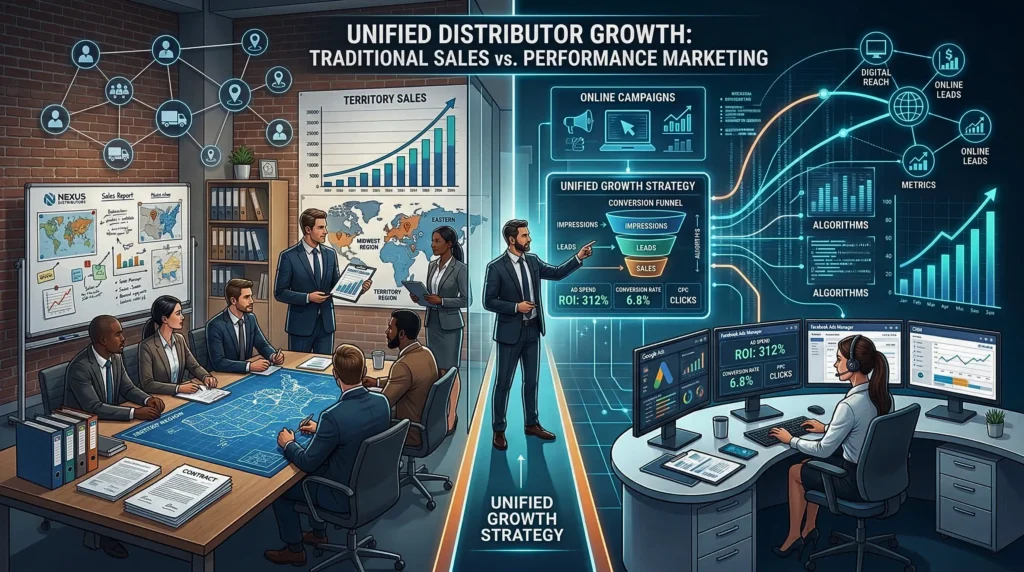
In today’s rapidly evolving business landscape, distributor networks are no longer driven by traditional methods alone. With the rise of digital platforms and data-driven strategies, companies are increasingly evaluating performance marketing vs traditional sales to determine which approach delivers better results.
For years, traditional sales methods have been the backbone of distributor networks. However, the emergence of performance marketing has introduced new opportunities for scalability, targeting, and measurable growth. Understanding the balance between performance marketing vs traditional sales is essential for businesses looking to strengthen their distribution channels and stay competitive.
Understanding Traditional Sales in Distributor Networks
Traditional sales rely heavily on physical interactions, relationship building, and field sales teams. Distributors and dealers engage directly with retailers, wholesalers, and customers to generate sales.
Key features of traditional sales include:
- Face-to-face relationship building
- Territory-based selling
- Manual sales tracking
- Dependence on dealer and distributor efforts
Traditional sales methods are particularly effective in markets where personal trust and long-term relationships play a crucial role. However, they often lack scalability and real-time performance tracking.
What is Performance Marketing?
Performance marketing is a digital-first approach where businesses pay for measurable outcomes such as clicks, leads, or conversions. It uses platforms like search engines, social media, and online advertising networks to drive targeted traffic and sales.
When comparing performance marketing vs traditional sales, performance marketing stands out for its ability to provide:
- Data-driven decision-making
- Real-time performance tracking
- Precise audience targeting
- Scalable growth opportunities
This approach allows businesses to optimize campaigns continuously and achieve better return on investment.
Key Differences Between Performance Marketing vs Traditional Sales
Understanding the differences between performance marketing vs traditional sales helps businesses choose the right strategy for their distributor networks.
1. Measurability
Performance marketing provides clear data on clicks, conversions, and ROI. Traditional sales, on the other hand, often rely on manual reporting and estimates.
2. Scalability
Performance marketing campaigns can be scaled quickly across multiple regions. Traditional sales require physical expansion, hiring, and training.
3. Cost Efficiency
With performance marketing, businesses pay for results. In traditional sales, fixed costs such as salaries and operational expenses remain constant regardless of performance.
4. Speed of Execution
Digital campaigns can be launched instantly, while traditional sales expansion takes time due to onboarding and training processes.
Challenges of Relying Only on Traditional Sales
While traditional sales are essential, relying solely on them can limit growth. In the debate of performance marketing vs traditional sales, businesses often find that traditional methods alone cannot meet modern market demands.
Common challenges include:
- Limited market reach
- Slow expansion into new regions
- Lack of data-driven insights
- Inconsistent sales performance across territories
These limitations highlight the need for integrating modern strategies into distributor networks.
Why Performance Marketing is Transforming Distributor Networks
Performance marketing is reshaping how distributor networks operate. By combining digital strategies with traditional channels, businesses can achieve faster and more efficient growth.
When comparing performance marketing vs traditional sales, performance marketing offers:
- Lead generation for distributors
- Increased brand visibility in new markets
- Better targeting of potential customers
- Improved conversion rates
Distributors can leverage digital leads to increase sales without relying entirely on physical outreach.
The Power of Combining Both Approaches
The real opportunity lies not in choosing between performance marketing vs traditional sales, but in integrating both strategies effectively.
A hybrid approach allows businesses to:
- Use performance marketing to generate leads
- Enable distributors to convert those leads into sales
- Strengthen both digital and offline presence
- Improve overall network efficiency
This combination ensures that businesses benefit from the strengths of both approaches while minimizing their weaknesses.
Building a Future-Ready Distributor Network
To succeed in the future, businesses must adapt to changing market dynamics. The comparison of performance marketing vs traditional sales highlights the importance of evolving beyond conventional methods.
Companies should focus on:
- Implementing digital marketing strategies
- Training distributors to handle digital leads
- Using analytics for better decision-making
- Creating integrated sales systems
By doing so, businesses can build distributor networks that are more responsive, scalable, and efficient.
Conclusion
The debate around performance marketing vs traditional sales is shaping the future of distributor network growth. While traditional sales provide strong relationship-building foundations, performance marketing offers speed, scalability, and measurable results.
Businesses that combine both approaches strategically can create powerful distribution systems capable of driving long-term growth. Instead of replacing traditional methods, performance marketing should be used to enhance them.
In competitive markets, the companies that successfully integrate performance marketing vs traditional sales will be the ones that achieve sustainable expansion and stronger market presence.